
5 reasons your team is failing (and how to fix them)
“Not finance. Not strategy. Not technology. It is teamwork that remains the ultimate competitive advantage, both because it is so powerful and so rare.”
You’ve likely heard the saying, “An organisation is only as good as its people”.
But if you manage people, you know the reality is far, far messier.
What makes human beings wonderful is also what makes them a pain in the neck sometimes.
So, if you find yourself managing others, it helps to understand what makes a team function well.
Thanks to Patrick Lencioni, author of The Five Dysfunctions of a Team: A Leadership Fable, you don’t have to figure these out on your own.
The book tells the tale of a fictitious Silicon Valley startup which is failing, but it’s not immediately clear to the board why.
They hire an experienced leader, Kathryn Petersen, to find the fix.
Spoiler alert: she discovers the company’s problems aren’t strategic or technical; they stem from a dysfunctional executive team.
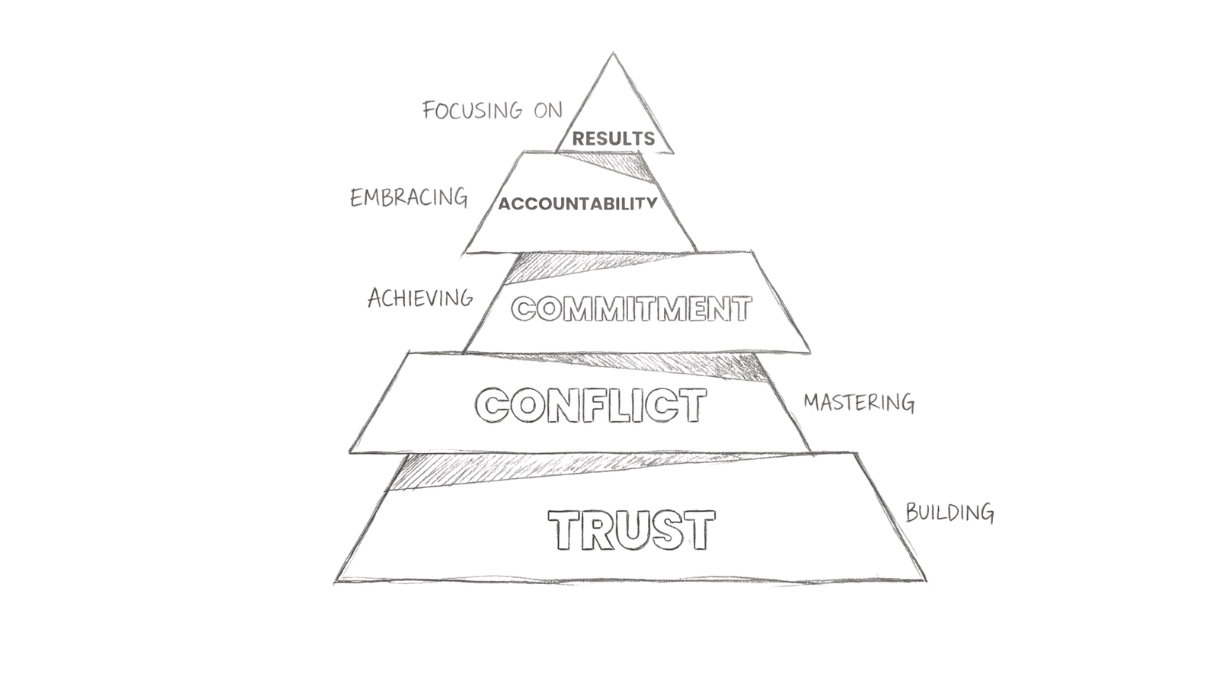
To save the company, Kathryn takes the team through a revealing process based on the ‘five dysfunctions’.
It’s important to note that it’s hierarchical. You can’t fix the top of the pyramid without getting the low levels in check.
Let’s take a look at each dysfunction (along with Lencioni’s suggested antidotes) below so you can learn how to identify and address them within your own company:
1. Absence of Trust
Mutual trust is the foundation of any healthy relationship. If team members can’t say “I was wrong” or “I need help,” you have a problem. Without trust, you cannot have an honest debate.
The Antidote: As a leader, you must show vulnerability first. Admit a mistake, a weakness, or a failure. If you are invulnerable, your team will be too.
2. Fear of Conflict
When trust is absent, teams fear conflict. They resort to “artificial harmony,” where everyone nods in the meeting but complains by the water cooler. Key issues get buried in the name of keeping the peace.
The Antidote: Call out the issues everyone’s skirting around. Ask the quietest person for their opinion and try establishing a “Real-time Permission” rule that interrupts uncomfortable silence by saying, “It is okay to disagree right now.”
3. Lack of Commitment
If people don’t air their opinions, they won’t buy into the decision. This leads to ambiguity, and the team leaves the meeting without a clear idea of what needs to be done.
The Antidote: Adopt the “Disagree and Commit” rule. Ensure everyone has been heard, then summarise the decision clearly. People can’t commit to something they don’t fully understand.
4. Avoidance of Accountability
If there is no commitment to a clear plan, you cannot hold people accountable. In this dysfunction, team members hesitate to call out peers on counterproductive behaviour. They look to the leader to be the sole disciplinarian.
The Antidote: You must make goals and standards public. Peer pressure is the most effective way to maintain high standards, but it only works when things are transparent.
5. Inattention to Results
Ego alert! The pursuit of individual goals and status (“My budget,” “My Project”) distracts from group progress. The organisation only achieves success when everyone is rowing in the same direction.
The Antidote: Ensure you define a single, shared team goal. Make sure you reward behaviours that contribute to the group outcome, not just individual heroism.
You can waste far too much time optimising finance or strategy, while the conditions for healthy teamwork are ignored.
If you had to say which one of the five dysfunctions is holding your team back right now, which would it be?
Start there & good luck!