'Morton's Fork'
A choice between two equally unpleasant alternatives.
John Morton was born in Dorset, England in the early 1400s.
In his early career he practised law before joining the clergy. There, he quickly rose through the ranks and was appointed Archbishop of Canterbury in 1486 under King Henry VII.
Just a year later, he became Lord Chancellor.
Morton’s main job in his new role was to organise the collection of taxes on behalf of the crown.
This was a particularly challenging task at the time as the royal coffers were in a sorry state having been drained by the previous King, Edward IV.
Morton’s response was to see that no one was given exception from taxation and made the following statement:
“If the subject is seen to live frugally, tell him because he is clearly a money saver of great ability, he can afford to give generously to the King. If, however, the subject lives a life of great extravagance, tell him he, too, can afford to give largely, the proof of his opulence being evident in his expenditure."
This type of false dilemma where two equally unpleasant alternatives lead to the same conclusion is known as ‘Morton’s Fork’. In more colloquial terms, it’s that popular expression ‘between a rock and a hard place.’
Perhaps the most well known example of a Morton’s Fork occurred to those accused of witch craft in the late medieval/early modern period of the 17th and 18th Centuries.
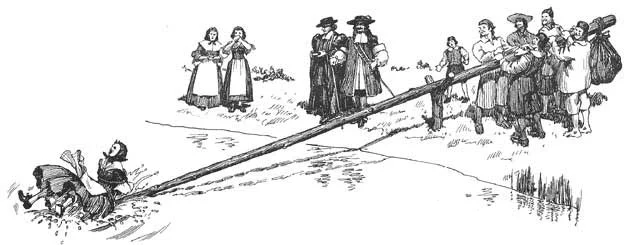
They were placed in a dunking chair over a river and lowered underwater.
If they floated they were deemed a witch and drowned. If they sank to the bottom and drowned they were innocent.
Either way, their number was up.
Are there any other great examples of a 'Morton's Fork' you've come across? Please let us know in the comments below.
Enjoyed this? There's more.
Weekend Reads every Friday, Weekday Wisdom every Tuesday.Plus 10% off your next purchase, right away.
Join 17,489+ curious people. Unsubscribe any time.
Comments
No comments yet. Start the conversation.